
By Tyson Schubert · Updated 29 July 2026 · 16 min read
At 45, I raced HYROX Sydney in 1:03:29, finished second in the 45-49 age group, and placed inside the top 70 overall.
That result matters to me. But the useful part is not the medal or the finish time.
It is what the race exposed.
Being over 40 was not my main limiter. Specific weaknesses in running durability, station execution, and fatigue management were.
That distinction changes how you train. Blame age and the answer becomes vague. Identify the limiter and the answer becomes practical.
This is the honest breakdown of what worked, what cost me time, and how I would prepare an athlete over 40 to race better.
Am I too old for HYROX?
No. Being over 40 does not automatically make you too old for HYROX.
HYROX combines eight 1 km runs with eight workout stations. It rewards aerobic capacity, strength-endurance, movement efficiency, pacing, and the ability to keep running after hard work. Those qualities can be trained at 40, 45, 50, and beyond.
The current official HYROX rules include age groups well beyond 40. That does not mean every athlete should train the same way. It means your date of birth is not a diagnosis.
Your training history, injury history, weekly capacity, technique, recovery, and limiter matter more than a generic rule about being “too old.” Do not use age as the explanation before the evidence points there.
My HYROX result at 45

I arrived in Sydney with a much clearer race plan than I had carried into an earlier race in Melbourne.
The earlier experience had been disappointing. It forced me to separate effort from execution and understand what each decision would do to the next kilometre.
In Sydney, the result was:
| Measure | Result |
|---|---|
| Finish time | 1:03:29 |
| Age on race day | 45 |
| 45-49 age group | 2nd |
| Overall position | Top 70 |
| Average run split | 3:53 |
| Roxzone | 6:11 |
The headline looks clean. The race was not.
My run splits ranged from 3:29 to 5:04. Some stations were efficient. Others were fast on paper but expensive when I looked at what happened immediately after them.
That is the first important lesson for any HYROX athlete:
A split is not good just because it is fast. It is good when it helps produce the best total race.
What the result does not show
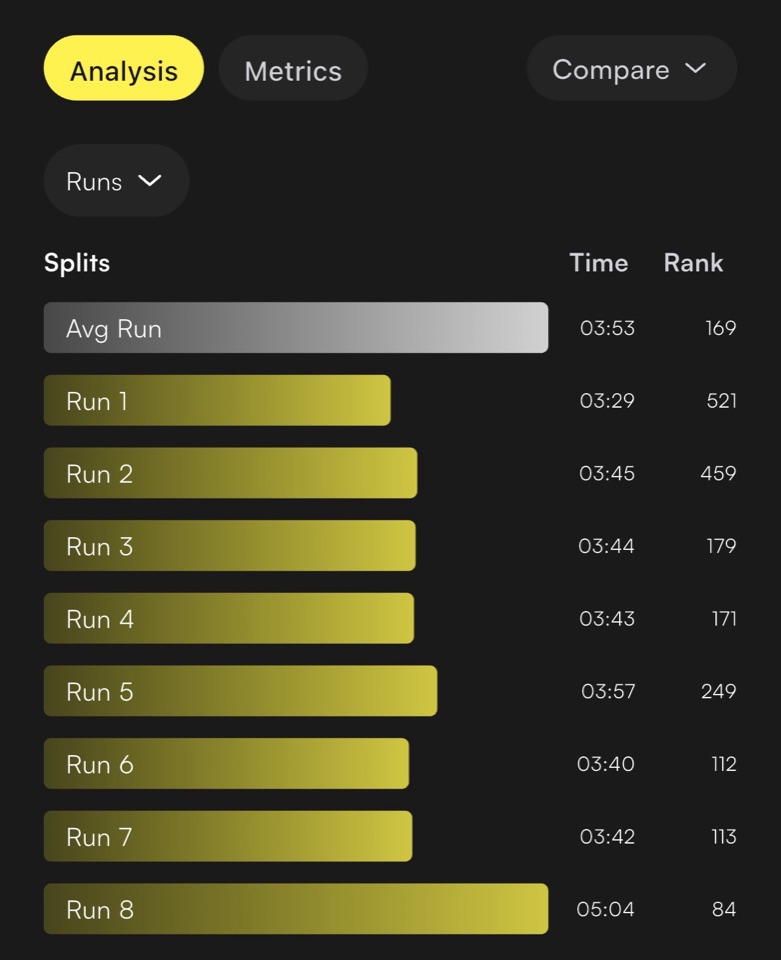
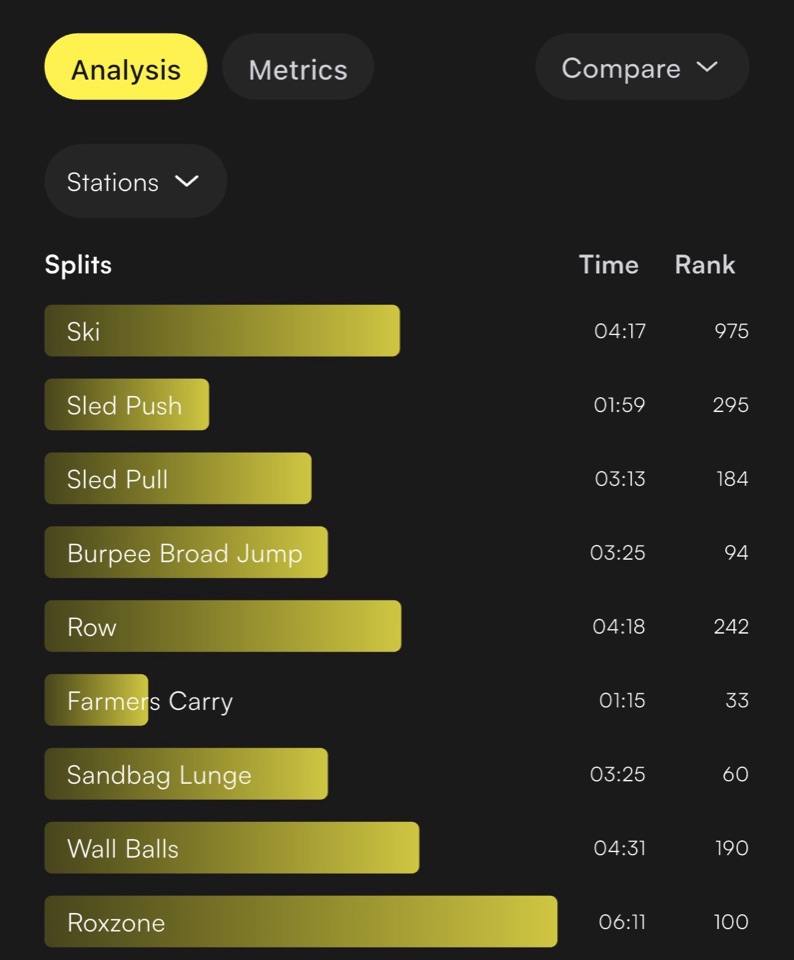
The result page cannot tell you why a split happened.
I deliberately controlled the SkiErg and row. I did not attack the sleds. That restraint was intentional, not weakness.
The SkiErg took 4:17. The row took 4:18. Those were not standout rankings. They were controlled efforts designed to keep the race intact.
The sled push was 1:59 and the sled pull was 3:13. Again, the goal was not to win those stations. The goal was to leave them able to run.
That strategy worked better than chasing a few seconds and paying for them over the next two kilometres.
HYROX is not eight separate tests. It is one continuous fatigue-management problem. The right effort is the hardest effort that protects the rest of your race.
What actually cost me time
Three areas shaped the back half of my race: burpee broad jumps, sandbag lunges, and wall balls.
1. Burpee broad jumps created the biggest downstream cost
My burpee broad jump split was 3:25, with a displayed station rank of 94.
On paper, that looks like a strength.
Physiologically, it was expensive.
The burpee broad jumps produced my largest heart-rate spike. I found it hard to settle after the station, and that carried into the following run. The station itself was fast, but the transition back to controlled running was not.
This is a classic hidden limiter. The result table rewards the station split. The body pays the combined cost of the station and the next run.
The fix is not simply “get fitter.” I need to improve the specific transition from repeated floor contact and jumping into economical running. That means practising cadence, breathing, controlled station exits, and short runs immediately after burpee broad jump work.
2. The lunges exposed local muscular durability
The sandbag lunges took 3:25 and ranked 60th in the displayed station data.
Again, that looks good.
But the lunges loaded my quads heavily. As fatigue rose, maintaining posture and protecting stride quality became harder. After the race, almost all meaningful soreness was bilateral quad soreness, and it lasted about three days. Very little else felt comparably affected.
That is useful evidence.
The problem was not general recovery. It was not that my whole body was destroyed because I was 45. The race created a very specific local cost.
My training response should be equally specific:
- build more quad strength-endurance;
- improve loaded-lunge posture under fatigue;
- practise the first 200 to 400 metres after lunges;
- avoid turning every lunge session into a maximal suffering contest.
3. The final 40 wall balls became survival
The wall balls took 4:31. The final 40 were the hardest part.
By then, the cost of the whole race was present: accumulated running, local quad fatigue, breathing demand, and the need to keep meeting the movement standard.
Wall balls punish bad decisions made much earlier. If the legs are already overloaded and breathing is uncontrolled, the last station exposes it.
The lesson is not to practise 100 fresh wall balls and assume the job is done. I need to practise wall balls with the legs and lungs already carrying race-like fatigue, using a break plan I can execute before failure forces one on me.
What hurt versus what limited performance
Pain and performance limitation are not the same thing.
| Race signal | What I felt | What it probably meant for performance | Training response |
|---|---|---|---|
| SkiErg | Controlled, not maximal | Protected later work | Keep the restraint and improve efficiency |
| Sleds | Deliberately controlled | Avoided an early strength tax | Maintain strength reserve and clean exits |
| Burpee broad jumps | Largest heart-rate spike | Damaged the following run | Train cadence plus immediate running |
| Farmers carry | Efficient | Genuine strength with low race cost | Maintain, do not overinvest |
| Sandbag lunges | Heavy quad fatigue | Reduced posture and stride quality | Build local durability and post-lunge running |
| Wall balls | Final 40 became very hard | Accumulated fatigue reached the last station | Rehearse planned breaks under fatigue |
| Post-race | About three days of bilateral quad soreness | Specific local overload, not total-system collapse | Adjust quad preparation, not the whole program |
This is the core LimiterIQ idea: the loudest sensation is not always the biggest limiter, and the fastest split is not always the best execution.
For a deeper diagnosis, use the guide to the six HYROX limiters.
How should HYROX training change after 40?
It should become more precise, not automatically easier.
An athlete over 40 does not need to train scared. They do need to earn progression, manage total load, and stop spending recovery on work that does not address the race.
Five principles matter.
Keep hard sessions hard enough to create adaptation
Age is not a reason to make every session moderate. A program with no real intensity often creates fatigue without improving race-specific performance.
Threshold running, strength work, and compromised-running sessions still matter. The dose and placement should match your current capacity.
Make easy work genuinely easy
The easiest way to ruin a good week is to turn recovery runs into quiet competitions. Easy work should support the next key session, not steal from it.
Progress one variable at a time
Do not increase running volume, station density, load, and intensity in the same week. Choose the adaptation you want, then make the smallest change that can produce it.
Protect movement quality
Technique becomes more important as fatigue rises. A poor lunge position or desperate wall-ball pattern can turn a fitness problem into a joint-tolerance problem.
Use evidence, not age-based fear
Track which sessions you complete well, where output falls, how your running changes after stations, and what remains sore. If a pattern repeats, respond to it.
If pain is sharp, worsening, or changes your movement, stop and seek qualified medical guidance. Training advice cannot diagnose an injury.
The six training priorities for HYROX over 40

1. Build running capacity first
Half the race structure is running, and every station is followed by more running.
You need enough easy volume to support durability, enough threshold work to raise controlled speed, and enough race-specific running to hold form under fatigue.
Start with the running threshold training guide or use the threshold pace calculator to set a practical baseline.
2. Train compromised running
Fresh running is not race running.
If your 5 km pace looks strong but your race kilometres collapse after stations, practise the transition. The goal is not to run blindly while exhausted. It is to regain posture, breathing, and rhythm faster.
Use short, controlled combinations such as:
- sled work, then 400 to 800 metres at controlled race effort;
- burpee broad jumps, then 400 metres focused on cadence;
- lunges, then 400 metres focused on posture;
- wall balls, then easy running to restore control.
The compromised-running drill gives this work a repeatable structure.
3. Build strength reserve
If every sled push or lunge is close to your maximum capacity, the race will be expensive.
Strength reserve means race loads consume a smaller percentage of what you can produce. You do not need to chase gym numbers for their own sake. You need enough force capacity that the race movement remains controlled.
4. Train strength-endurance where it actually fails
Raw strength and repeatable force are different.
My lunge result showed that I could move quickly. My quad response showed that sustaining quality through the total race was the real issue.
Use the strength-endurance guide to distinguish a force problem from a fatigue-resistance problem.
5. Make station technique automatic
Technique saves oxygen, time, and decision-making.
Prioritise the stations most likely to disrupt your race:
- burpee broad jump cadence;
- sandbag lunge posture and rhythm;
- wall-ball breaks and breathing;
- erg pacing.
6. Train the limiter, maintain the strengths
My farmers carry ranked 33rd. It was not where I needed to spend most of my next block.
Strong athletes often keep training what makes them feel competent. Better athletes protect their strengths with a maintenance dose and spend their best attention on the part of the race that keeps costing them.
Example HYROX training weeks for athletes over 40
There is no universal perfect week. The best structure is the one you can recover from, repeat, and progress.
Three-session week
| Day | Focus | Example |
|---|---|---|
| Session 1 | Running quality | Threshold intervals with full control |
| Session 2 | Strength plus station skill | Squat or hinge, push and pull, then one technical station |
| Session 3 | Race-specific durability | Easy-to-steady running with controlled station inserts |
This works for athletes with limited time, newer athletes, or anyone rebuilding consistency.
Four-to-five-session week
| Day | Focus |
|---|---|
| Monday | Easy aerobic run plus mobility |
| Tuesday | Lower-body strength and sled or lunge skill |
| Wednesday | Rest |
| Thursday | Threshold or controlled intervals |
| Friday | Upper-body strength, carry, and erg technique |
| Saturday | Compromised-running session |
| Sunday | Rest or very easy aerobic work, based on actual recovery |
Experienced athlete week
An experienced athlete may tolerate two running-quality exposures, two strength or station sessions, and one longer race-specific session, provided easy days stay easy and key sessions retain quality.
Use the training week template to arrange sessions around your schedule rather than copying someone else’s calendar.
A practical 12-week HYROX framework
| Phase | Weeks | Main goal | What success looks like |
|---|---|---|---|
| Foundation | 1-4 | Aerobic consistency, strength reserve, movement quality | Sessions finish with repeatable form |
| Specific build | 5-8 | Compromised running and limiter-specific work | Faster recovery after stations |
| Race execution | 9-10 | Rehearse pacing, transitions, and break plans | Stable total sessions, no early blow-up |
| Sharpen and reduce | 11 | Lower volume, preserve intensity and confidence | Freshness rises without feeling flat |
| Race week | 12 | Arrive ready, not “extra fit” | No last-minute fitness tests |
Do not force the calendar if your training history does not support it. Repeat a phase when quality is not stable. Skip the temptation to compress twelve weeks of work into six weeks of panic.
For the final days, use the race-week checklist.
Station-by-station lessons from my race
| Station | Sydney split | Honest lesson | Next-block priority |
|---|---|---|---|
| SkiErg | 4:17 | Controlled effort protected the race | Maintain pacing, improve efficiency |
| Sled push | 1:59 | No need to win the station | Preserve clean force and exit control |
| Sled pull | 3:13 | Strength was adequate | Maintain technique and grip |
| Burpee broad jumps | 3:25 | Fast split, large downstream cost | Cadence plus immediate running |
| Row | 4:18 | Restraint was useful | Keep breathing controlled |
| Farmers carry | 1:15 | Clear strength | Maintenance dose only |
| Sandbag lunges | 3:25 | Good split, high quad cost | Local durability and posture |
| Wall balls | 4:31 | Final 40 exposed accumulated fatigue | Planned breaks under fatigue |
Which HYROX division should you choose after 40?
HYROX currently offers individual Open and Pro divisions, plus Doubles and Relay formats. Check the official race format and current rulebook before registering because standards can change.
Choose Open if you want the full individual race and the standard loads match your current preparation.
Choose Pro if the heavier loads are already a trained capacity and they will not turn the race into eight survival tests.
Choose Doubles if you want the full running format with shared station work.
Choose Relay if you want a lower individual volume, a team experience, or a sensible first exposure to the event environment.
The best division is the one you can prepare for honestly.
Race-day advice I would give any athlete over 40
Use the dedicated HYROX warm-up over 40 guide to personalise START-10 from four readiness signals without assuming your age dictates the dose.

Make the first 15 minutes feel almost boring
Use the race calculator and four-phase pacing model to decide your opening effort before adrenaline decides it for you.
Leave every station able to run
The station is not finished when you cross its line. It is finished when you have regained useful running rhythm.
Use planned breaks before failure
Wall-ball and lunge plans should be decisions, not emergency reactions. Break while the next set is still predictable.
Protect technique when tired
Fatigue is not permission to abandon standards. Efficient movement is often the fastest remaining option.
Do not introduce anything new on race week
No new shoes, new fuel, new supplements, or heroic final session. Confidence should come from completed work, not last-minute risk.
What I would do differently next time
I would not rebuild everything.
I would keep the controlled SkiErg, row, and sled approach. Those decisions helped.
I would change four things:
- More running immediately after burpee broad jumps. Not more random burpees. Better transition practice.
- More quad durability for lunges. Strength, posture, and running after local fatigue.
- More wall balls under controlled race fatigue. A rehearsed break plan before the final 40.
- More attention to total-race cost. A station PB is irrelevant if it creates a larger loss immediately after.
That is a much better plan than blaming age and adding more recovery to every week.
Can you still be competitive at HYROX after 40?
Yes.
At 45, I raced in 1:03:29 and finished second in my age group.
That does not prove age is irrelevant. It proves that “over 40” is too broad to be a useful diagnosis.
You may need smarter load management, more consistency, less junk volume, and greater respect for injury history. You can still improve.
The honest question is not:
“Am I too old?”
It is:
“What is the clearest reason my performance falls apart, and am I training it directly?”
HYROX over 40 FAQ
Is 40 too old to start HYROX?
No. Start from your current capacity, choose an appropriate division, and build progressively. Seek qualified guidance before increasing load if you have a medical condition, significant pain, or a long training layoff.
How many days a week should I train for HYROX after 40?
Three well-designed sessions can work. Four or five can work for athletes with the history and recovery to support them. The minimum effective structure you can repeat is better than an impressive week you cannot sustain.
Should HYROX athletes over 40 avoid high intensity?
Not automatically. High-intensity work can be useful when the dose, exercise choice, and placement fit the athlete. The mistake is stacking too much high-cost work without enough easy training or recovery.
Is running or strength more important for HYROX over 40?
The answer depends on your limiter. Weak running durability can damage every section of the race. Insufficient strength reserve can make stations too expensive. Diagnose the larger cost instead of choosing a side.
How much running should I do for HYROX?
Enough to build aerobic consistency, threshold control, and the ability to run after stations without your form collapsing. Weekly distance is individual. Progress gradually and track whether quality improves.
How should I train compromised running?
Pair a controlled dose of station work with a short run. Focus on regaining posture, cadence, and breathing rather than sprinting in a destroyed state. Progress the combination only when technique stays stable.
What are the hardest HYROX stations for older athletes?
There is no universal answer. In my race, burpee broad jumps created the biggest cardiovascular spillover, lunges created the largest local muscular cost, and the final wall balls exposed accumulated fatigue. Your evidence may point elsewhere.
Should I race Open, Pro, Doubles, or Relay?
Choose based on trained capacity and the experience you want. Open and Pro are full individual races with different loads. Doubles share station work. Relay divides the event across a team. Verify the current official rules before registering.
How long do I need to prepare for HYROX?
Twelve weeks is a useful framework when you already have a reasonable base. Newer athletes may need longer. A compressed plan cannot replace months of consistent running, strength, and movement practice.
What should I do if one station always ruins my race?
First determine whether the issue is strength, technique, pacing, or the transition back to running. Then train that exact failure mode while maintaining your strengths.
How do I recover better after 40?
Start with training load you can tolerate, enough food, regular sleep, easy days that remain easy, and honest attention to persistent pain or declining performance. Do not use recovery tactics to make an unsustainable program sustainable. See the recovery and sleep guide for a practical framework.
What is the biggest HYROX mistake athletes over 40 make?
Treating age as the limiter before examining the race. That can lead to vague, cautious training while the actual weakness remains untouched.
The next step
You do not need more random suffering.
You need to know whether your race is being limited by the engine, compromised running, strength-endurance, pacing, a specific station, or recovery.
LimiterIQ provides training guidance and performance education. It does not provide medical diagnosis, injury diagnosis, physiotherapy, rehabilitation, or emergency advice.
LimiterIQ is independent and is not owned by, endorsed by, partnered with, sponsored by, certified by, approved by, or officially affiliated with HYROX World GmbH. HYROX is referenced descriptively only.