
The answer first
For HYROX sleep recovery, start with the Australian adult guideline of 7 to 9 hours of good-quality sleep with consistent bed and wake times. Then review opportunity, continuity, timing and next-day function across several nights. One poor night is context. A repeated pattern that affects safety, alertness or session quality is a reason to adjust load or seek qualified advice.
The alarm goes off after a broken night. Your programme says intervals. Your watch says recovery is poor. The fastest solution appears obvious: cancel the session, blame sleep and start searching for a supplement.
That response feels cautious, but it still skips the real decision. A single device score cannot tell you whether the problem was too little sleep, an interrupted night, a shifted schedule, illness, stress, the previous training load or plain measurement noise. Sleep matters. Guessing about sleep does not help.
The Australian Government's 2026 movement guidelines recommend 7 to 9 hours of good-quality sleep for adults aged 18 to 64, with consistent bed and wake times. Athlete research also supports a performance cost from sleep loss. A 2023 meta-analysis found a moderate negative effect on endurance performance, with longer efforts more affected. Another meta-analysis across 69 publications reported a negative effect across endurance, strength, strength-endurance, high-intensity and skill outcomes, although the studies were heterogeneous and predominantly male.
That evidence supports protecting sleep. It does not support rigid sleep-cycle arithmetic, precise claims about which stages disappear after a short night, or guaranteed skill-loss percentages. Sleep stages vary within and between people. A useful training decision needs a pattern, not a dramatic number.
Use the Sleep Load Map
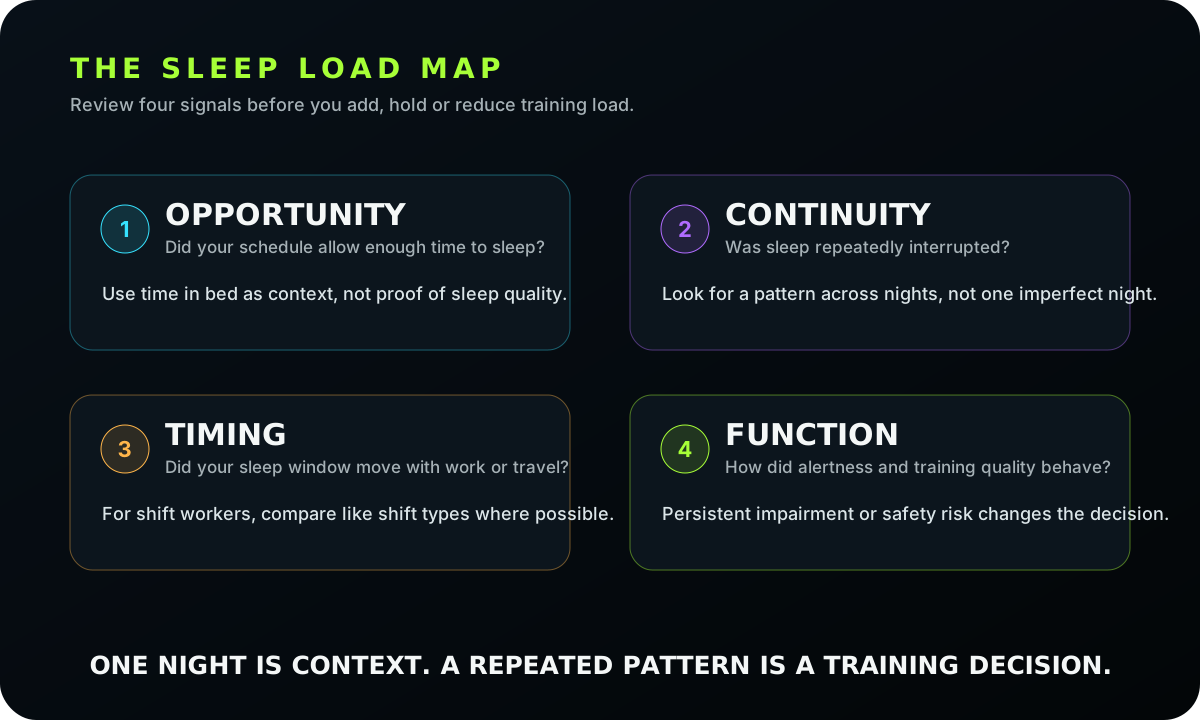
1. Opportunity: was enough time available?
Start with the schedule. Time in bed is not the same as time asleep, but it tells you whether adequate sleep was even possible. A planned six-hour window is a different problem from spending nine hours in bed and waking unrefreshed.
Do not turn 7 to 9 hours into a pass-fail score. It is a population guideline for healthy adults. Individual needs, chronic conditions, medication, pregnancy, age and roster demands can change the picture. Use the range as a starting point and the pattern of function as context.
2. Continuity: was sleep repeatedly interrupted?
A long sleep window can still be fragmented by a hot room, noise, caring responsibilities, pain, stress or a sleep disorder. You do not need to count every awakening. Record whether the night felt mostly continuous, repeatedly broken or uncertain.
One disrupted night before an important session is inconvenient. Repeated disruption with unrefreshing sleep or daytime impairment deserves more attention. The distinction prevents a bad night from becoming a story about lost fitness while still respecting a real pattern.
3. Timing: did the sleep window move?
Timing matters because sleep and circadian rhythms are linked. For an athlete on a stable daytime schedule, large shifts in bed and wake time can make the week harder to read. For a shift worker, perfect clock-time consistency may be impossible and the useful comparison is often between similar shift types.
The Sleep Health Foundation's 2026 guidance for shift workers recommends aiming for 7 to 9 hours per 24 hours, building a schedule around the roster, planning transitions to days off and using light, caffeine, naps and the sleep environment deliberately. These are options to individualise, not a rigid prescription.
4. Function: what happened the next day?
Function closes the loop. Review alertness, safe driving, concentration, mood, warm-up response and whether movement quality changed. Also review the planned session. A low-cost easy session and a maximal technical session do not carry the same consequence if judgement or coordination is poor.
Wearable estimates can add context, but consumer devices do not diagnose insomnia or sleep apnoea. A consistent morning note is often more useful than reacting to a single proprietary score: sleep opportunity, interruptions, schedule shift, alertness and planned training demand.
Make the training decision
Use the map to choose the smallest defensible change. Do not reward a poor night with panic and do not prove toughness by ignoring a safety problem.
| Pattern | Training response | Boundary |
|---|---|---|
| One poor night, alert and moving normally | Keep the plan or reduce non-essential volume. Extend the warm-up and review again. | Do not add punishment work later to make up for uncertainty. |
| Several short or broken nights with declining session quality | Protect the key session, remove optional intensity and rebuild sleep opportunity. | Hold progression until normal function returns. |
| Marked sleepiness, impaired judgement or unsafe travel | Prioritise safety. Do not force a demanding session. | Training completion never outranks safe driving or equipment use. |
| Adequate opportunity but persistent unrefreshing sleep | Record the pattern and discuss it with a doctor. | Do not self-diagnose or use a training article as treatment. |
Run a seven-day sleep experiment
The point of a short experiment is not to perfect sleep in a week. It is to make the signal more readable without buying a device or changing five variables at once.
- Choose one schedule target: protect enough sleep opportunity or make bed and wake timing more repeatable for the current shift type.
- Choose one environment target: reduce light, noise or interruptions that you can realistically control.
- Record five fields each morning: opportunity, continuity, timing shift, alertness and that day's training demand.
- Do not start a new supplement stack: it would make the experiment less readable and may create health or medication risks.
- Review the week: did normal function and key-session quality improve, remain uncertain or worsen?
If the pattern improves, keep the useful constraint. If it remains uncertain, hold rather than inventing precision. If it worsens or includes concerning symptoms, use qualified care.
FIFO and shift work need a different standard
A fixed 10 pm bedtime is not serious advice for an athlete rotating between day and night shifts. The goal is not to imitate a daytime worker. It is to protect total sleep, plan the transition and reduce avoidable conflict between the roster and training.
- Build a repeatable sleep plan for each shift type rather than expecting one clock time to fit every roster.
- Use a main sleep period plus a shorter sleep when needed to approach the total sleep target.
- Keep the room dark, quiet and comfortable when sleeping during daylight.
- Place demanding training where alertness and safe travel are strongest, not merely where the calendar is empty.
- Plan the return to days off instead of making the transition after fatigue has already accumulated.
These are general principles. A sleep physician, sleep psychologist or GP can help when the roster creates ongoing sleep or safety problems.
Put recovery context beside your limiter evidence
Use the LimiterIQ assessment to organise the training problem you can act on. It does not measure sleep stages or diagnose recovery.
Find my current limiterSleep recovery FAQ
How much sleep should a HYROX athlete get?
Australian guidance recommends 7 to 9 hours of good-quality sleep for adults aged 18 to 64, with consistent bed and wake times. Individual needs and circumstances vary, so use that range as a starting point rather than a performance guarantee.
Should I skip training after one bad night of sleep?
Not automatically. Treat one poor night as context. Review safety, alertness, the planned session and the pattern across recent nights. Reduce or move non-essential intensity when judgement, movement quality or safe travel is affected.
What should FIFO and shift-working athletes do about sleep?
Aim for 7 to 9 hours across each 24-hour period where possible, build a repeatable schedule for each shift type, protect a dark and quiet sleep environment, and plan transitions to days off. Seek professional advice if sleep problems persist.
When should poor sleep be discussed with a doctor?
Speak with a doctor when trouble sleeping persists, sleep does not feel refreshing, mood or daytime function is affected, or there is loud snoring, gasping, choking or marked daytime sleepiness. This article cannot diagnose a sleep disorder.
Sources and evidence limits
- Australian Government, 24-hour movement recommendations for adults. Updated 3 June 2026.
- American Academy of Sleep Medicine and Sleep Research Society adult sleep-duration consensus. 2015.
- Walsh et al., Sleep and the athlete: 2021 expert consensus recommendations. British Journal of Sports Medicine.
- Lopes et al., sleep deprivation and endurance performance. Systematic review and meta-analysis, 2023.
- Craven et al., acute sleep loss and physical performance. Systematic and meta-analytical review, 2022.
- Sleep Health Foundation, healthy sleep practices for shift workers. 20 January 2026.
- Healthdirect Australia, insomnia. Accessed 2 September 2026.
- Healthdirect Australia, obstructive sleep apnoea. Accessed 2 September 2026.
The performance literature contains small studies, mixed protocols and under-representation of women. Findings from total sleep deprivation do not map perfectly to a normal short night. LimiterIQ therefore uses the evidence to support cautious decision rules, not guaranteed performance percentages.
Continue the decision
Stop treating every flat session as the same problem
Map the limiter first, then decide what training deserves your recovery capacity.
Start the free assessment