
The answer first
Build a HYROX aerobic base by making controlled aerobic work repeatable, retaining essential strength and race skill, then progressing only one load variable at a time. There is no mandatory 80/20 split and no single workout that diagnoses your engine. Start from the load you already tolerate, not the week you wish you could survive.
You finish an easy run and feel almost guilty. No dramatic split. No floor time. No proof for the group chat. The next day, the temptation is to add intervals because the session did not feel hard enough to count.
That temptation is exactly why many hybrid athletes never complete a useful base block. Easy days drift towards moderate. Strength stays heavy. A simulation gets added on Saturday. Each session looks defensible alone, but the week becomes one long recovery bill.
HYROX alternates eight one-kilometre runs with eight functional workout stations. That format makes aerobic capacity important, but it also means a base-only plan is incomplete. You still need enough strength to move external load and enough skill to perform the stations efficiently. The goal is not to become a distance runner for a month. It is to expand the amount of work you can absorb without losing the other qualities your race requires.
What an aerobic base actually gives you
An aerobic base is your capacity to produce and repeat work predominantly through aerobic metabolism at a controlled cost. In practice, that can show up as easier conversational running, more stable effort across repeated work and faster recovery between training exposures. Those are useful observations, not a medical diagnosis and not proof from one session.
A comfortable talk test is a practical field anchor. Research supports comfortable speech as a rough way to stay below ventilatory or lactate threshold for many people. It is not a substitute for laboratory testing, and heat, hills, fatigue, medication and illness can all change the relationship between pace, heart rate and effort.
The common misdiagnosis: more Zone 2 at any cost
“Do more Zone 2” sounds precise, but it leaves the hardest decisions unanswered. More than what? Added where? Which strength session moves? What signal tells you the dose was too high?
The familiar 80/20 rule is not a universal prescription. Reviews of endurance training distribution find that polarised training can help some outcomes, particularly in certain trained populations, but it is not consistently superior across every performance measure. A 16-week comparison in trained runners also found only small differences between periodised and polarised approaches. The evidence supports deliberate distribution and individualisation, not a magic percentage for every hybrid athlete.
The other fear is that aerobic work automatically erases strength. A large review of concurrent aerobic and strength training found no general interference with maximal strength or muscle growth, while explosive strength appeared more sensitive, especially when training modes were combined in the same session. That makes scheduling and total load important. It does not make aerobic training incompatible with strength.
Use the BASE-4 constraint map
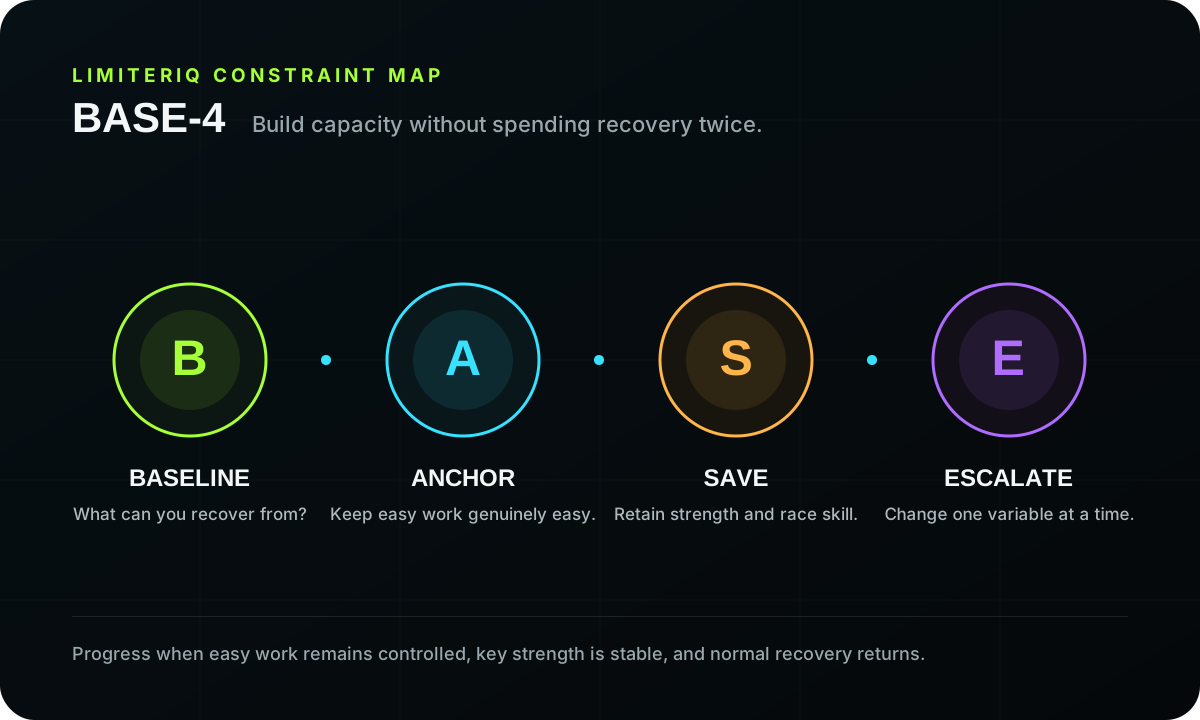
B: Baseline what you can recover from
Start with the last two to four normal weeks, not your best week from last year. Count running, ergs, high-repetition stations, team sport and physically demanding work. A FIFO roster, broken sleep or a sudden increase in steps changes what “normal” means.
Choose a first-week dose you have good reason to tolerate. If you currently run twice, adding a short third easy exposure is a clearer experiment than doubling the length of both runs. ACSM guidance emphasises individualisation and gradual progression. Evidence for one universal percentage rule for running-load increases remains limited and conflicting, so this framework deliberately avoids a fake injury-proof number.
A: Anchor genuinely easy work
Use one or two simple controls. Comfortable conversation is often more transferable than chasing a generic heart-rate zone. A calm breathing rhythm and stable perceived effort can help. On hills, slow down. On a hot day, accept a slower pace. The training target is the internal effort, not winning an easy-run screenshot.
If every easy session becomes moderate, you spend fatigue without getting a clean high-intensity stimulus. Keep harder aerobic work purposeful and count it alongside sleds, lunges, wall balls and demanding strength sessions. Your body does not file fatigue by workout label.
S: Save the strength and skill the race still needs
Retain a small number of high-value strength exposures. Prioritise movement quality and enough heavy work to maintain the qualities you already own. Keep a low-cost touch of race skill, such as controlled wall-ball sets, efficient burpee broad-jump rhythm or short station transitions. Base season is a shift in emphasis, not permission to forget the event.
Where practical, separate demanding aerobic and strength work. If they must share a day, choose the order from the priority of the block and avoid turning both halves into maximal sessions. The point is to preserve quality, not follow a ritual.
E: Escalate one variable
Progress only after the current week behaves as intended. Add duration to one easy session, add one short easy exposure, or slightly increase a purposeful quality dose. Do not change frequency, duration and intensity together. One-variable progression makes the athlete's response readable.
Hold the load when easy work is no longer controlled, normal soreness persists, sleep or mood deteriorates, or key strength falls across repeated exposures. Reduce and seek appropriate professional advice when pain changes your movement, symptoms are unusual, or illness is suspected.
A base week is a shape, not a template
The following example shows relationships between sessions. It is not a personalised prescription. The right number of days depends on your history, division, roster, injury history, available equipment and current total load.
| Session role | What it protects | Control question |
|---|---|---|
| Two or more easy aerobic exposures | Repeatable volume and aerobic practice | Could you speak comfortably and train as planned next day? |
| One purposeful aerobic quality session | Higher-end aerobic stimulus | Is it distinct from easy work, or just more grey-zone fatigue? |
| Two strength exposures | Force, tissue capacity and movement quality | Are key lifts or patterns stable across the block? |
| One low-cost race-skill touch | Station economy and familiarity | Can you practise without making it another race simulation? |
| Recovery space | Adaptation and schedule resilience | Where can a hard day move when work or sleep changes? |
Beginners may need fewer sessions and more repetition of the same simple week. Experienced athletes may tolerate more volume but still benefit from the same constraints. A base block earns complexity only when the simple version is stable.
The next-week decision
Do not ask only, “Did I complete every session?” Completion can hide a badly priced week. Review three signals together:
- Control: did easy work remain conversational or otherwise controlled?
- Retention: did your selected strength and skill markers remain broadly stable?
- Recovery: did normal readiness return before the next key session?
If all three are stable, change one variable. If one is drifting, hold. If several are worsening, reduce the load and investigate the cause. This is a coaching decision rule, not a diagnostic test.
Find the limiter your base block should support
Use the LimiterIQ assessment to organise your next training decision around your current constraint. It is a guide, not a medical diagnosis.
Find my current limiterAerobic base FAQ
What is aerobic base training for HYROX?
Aerobic base training develops the capacity to complete more work at a controlled effort and recover between repeated efforts. For HYROX, it supports the running and recovery demands around the functional stations, but it does not replace strength, skill or race-specific practice.
Does aerobic base training have to follow an 80/20 split?
No. Research on endurance training distribution does not establish one universal split for every athlete. Use easy work as the anchor, keep the hard work purposeful and choose the balance that fits your training history, total load and recovery.
Will easy aerobic work make me lose strength?
Not automatically. Evidence on concurrent training generally supports combining aerobic and strength work, although explosive strength can be more sensitive when both are crowded into the same session. Retain key strength work and separate demanding sessions when practical.
How should I progress an aerobic base block?
Change one variable at a time, such as the duration of one easy session or the number of weekly easy sessions. Hold or reduce the load if easy work stops feeling controlled, key strength falls, pain changes your movement, or normal recovery does not return.
Evidence and sources
LimiterIQ separates official event facts, research findings and coaching inference. BASE-4 and its decision rules are LimiterIQ coaching synthesis. They have not been validated as a clinical or predictive instrument.
- HYROX: About the race. Official description of the event structure. Accessed 19 August 2026.
- Rosenblat et al. (2024). Systematic review and meta-analysis of polarised versus other endurance-training distributions.
- Filipas et al. (2022). Sixteen-week training-distribution comparison in trained endurance runners.
- Schumann et al. (2022). Systematic review and meta-analysis of concurrent aerobic and strength training.
- Damsted et al. (2018). Systematic review of running-distance changes and running-related injury.
- American College of Sports Medicine (2011). Position stand on exercise prescription and progression.
- Reed and Pipe (2014). Systematic review of the talk test as an exercise-intensity guide.