
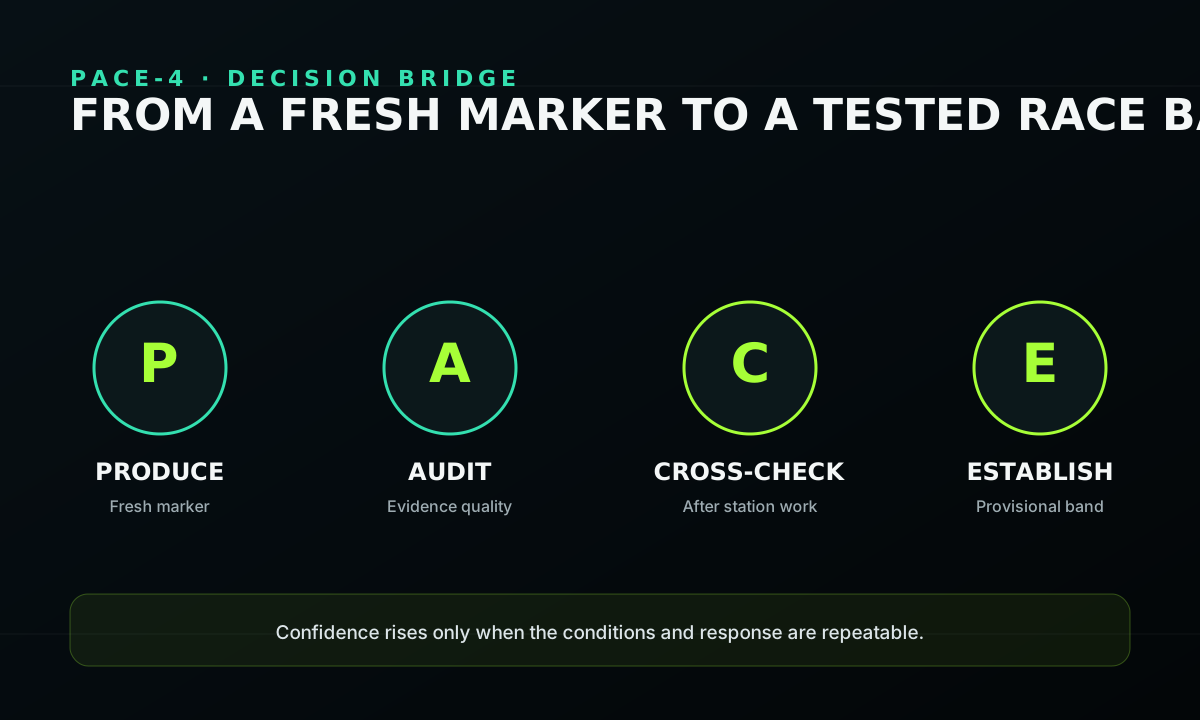
The answer: use threshold pace as a fresh marker, not a race command. Produce an estimate, audit its quality, cross-check it after station work, then establish a provisional race band. That four-step process is PACE-4.
You finish a 30-minute test, look at the average pace and feel relief. At last, a clean number. The temptation is to add a fixed number of seconds per kilometre and call the result your HYROX pace.
That shortcut feels precise. It is not well supported. HYROX alternates a one-kilometre run with a functional station eight times. The running marker is fresh; the race is a repeated decision under accumulating load. Station execution, transitions, course layout, temperature and opening restraint all affect what you can repeat.
Threshold is a family of concepts, not one magic line
Coaches often use “threshold” as if everyone means the same thing. A review of endurance testing found 25 different threshold concepts, grouped into three broad categories. A pace from a blood-lactate test, a ventilatory test, a critical-speed model and a field time trial are related ideas, not interchangeable measurements.
Even maximum lactate steady state does not map to one universal blood-lactate value. A review reported concentrations ranging from 2 to 8 mmol/L between individuals. A generic “4 mmol/L equals threshold” graphic can look scientific while hiding meaningful individual variation.
For practical HYROX planning, the clean label is fresh threshold estimate. It describes what happened in one running test under recorded conditions. It does not directly measure blood lactate, diagnose physiology or prove a race pace.
Research supports the usefulness of several threshold methods in endurance sport. Using a fresh estimate as a HYROX planning input is a coaching inference. The race conversion must be tested against your own compromised-running response.
P · Produce a fresh marker you can repeat
A laboratory test can provide richer physiological information when it uses a defined protocol and is interpreted by a qualified practitioner. For most athletes, a field test is cheaper and easier to repeat.
A 30-minute time trial is one option. In a small study of 27 competitive distance runners and triathletes, velocity and heart rate from a 30-minute time trial did not differ significantly from the study’s fixed 4.0 mmol/L laboratory criterion, not an individually measured maximum lactate steady state. The reported standard errors were 0.21 m/s for velocity and 8 beats per minute for heart rate. Useful, but not exact, and not HYROX-specific.
A defensible field-test protocol
Use the overall performance and shape of the effort as the marker. A strong result is not simply the fastest average. It is an effort paced coherently enough to interpret.
A · Audit before the number earns authority
Tests create confidence because they return a number. The audit asks whether that number deserves to influence a race plan.
| Status | Evidence | Decision |
|---|---|---|
| Usable | Measured setting, no interruption, controlled opening, broadly stable mechanics and current fitness. | Carry it into a station cross-check as a provisional marker. |
| Questionable | Heat, wind, uneven terrain, uncertain treadmill calibration, heavy fatigue or large pacing swings. | Keep the context visible. Repeat before a high-stakes race decision. |
| Invalid | Wrong distance, unrelated stop, illness, pain, device failure or an opening effort that destroyed the test. | Do not convert it. Correct the cause and test again when appropriate. |
Heart rate can help describe the test, but it should not overrule the full context. Heat, hydration, fatigue, caffeine and device error can move it. Perceived effort is also information, not a laboratory instrument.
C · Cross-check after station work
HYROX research is still young. A 2025 laboratory simulation with 11 recreational participants found that stations produced higher heart rate, blood lactate and perceived exertion than the running bouts. The sample was small, used a curved treadmill and cannot supply a universal pace adjustment. It does support the problem your plan must test: station work changes the next run.
Use a controlled compromised-running drill you can repeat safely. Keep run distance, station choice, load, sequence and recovery consistent. Start conservatively. The purpose is not to simulate an entire race every week. It is to observe whether a candidate pace remains controlled after a familiar dose of station work.
Capture evidence, not just a finish time
If the runs deteriorate, the fresh test has not failed. It told you only part of the story. Lower the candidate pace, reduce an over-aggressive station dose, improve station efficiency or build the missing capacity. Change one variable, then observe again.
There is no evidence-backed rule that every athlete should add the same 15, 20 or 30 seconds per kilometre. A cross-check can narrow a band. It cannot reproduce every venue, Roxzone, queue, surface or race-day decision.
E · Establish a race band, not a fragile target
A race band gives you room to respond without abandoning the plan. Express it as a narrow range supported by recent testing, not a single aspirational split.
The opening kilometres should usually sit away from the ceiling. That is a decision principle, not a fixed percentage. Use your stable cross-check, race experience and the SPEND-5 full-race pacing framework to choose how conservative the opening needs to be.
A 2026 analysis of 39,696 HYROX Pro and Elite results found running accounted for about half of total race time and was strongly aligned with final placing. It did not prove that forcing a faster run causes a better result, and it did not include Open or Doubles athletes. The useful inference is that repeatable running matters enough to plan carefully, while stations and transitions still constrain the plan.
The decision bridge
| What you observe | What it means | Next decision |
|---|---|---|
| Fresh test is usable. Compromised work stays controlled. | The provisional band has supporting evidence. | Repeat under comparable conditions before raising the ceiling. |
| Fresh test is usable. Post-station pace or mechanics deteriorate. | The race limiter is not explained by fresh running alone. | Lower the band and isolate station intensity, efficiency or recovery. |
| Fresh test is questionable or invalid. | The input is weak. | Do not convert it. Repeat when conditions are suitable. |
| Symptoms or pain alter the effort. | Performance interpretation is no longer the priority. | Stop. Seek appropriate medical or allied-health advice if needed. |
Use the race calculator only to stress-test the whole time model. It is planning arithmetic, not proof of the pace you can sustain. Place the work in a balanced training week, then protect recovery before your next decision session.
Retest after a meaningful training block, after a material change in fitness, or when the old result no longer matches what you observe. A fixed six- or eight-week schedule is not a law. Comparable conditions often make a retest more useful than a perfectly regular date.
Sources and limits
- HYROX: About the race. Official description of the standard race sequence.
- McGehee et al. (2005). Small comparison of field methods and a laboratory criterion.
- Faude et al. (2009). Review of lactate-threshold concepts and diagnostic methods.
- Billat et al. (2003). Individual variability in maximum lactate steady-state concentration.
- Brandt et al. (2025). Small physiological study of a HYROX simulation.
- Rappelt et al. (2026). Large retrospective analysis of HYROX Pro and Elite results.
Turn evidence into your next decision.
The free LimiterIQ assessment organises evidence across eight systems. It does not measure lactate or calculate a race pace.