
The opening feels cheap because the bill has not arrived yet. Fresh legs, noise and people moving around you can make a pace feel sustainable when it has only been tested for a few minutes. The expensive part appears later: an exit you cannot settle, a station that changes from work to survival, or a run band that keeps drifting away.
That does not mean everyone should start slowly, chase even splits or copy a professional athlete. It means the race needs a decision system. The current Singles rulebook defines 8,000 metres of running across eight approximately 1,000-metre segments, separated by eight functional stations. Venue layout and Roxzone movement add context that a simple kilometre target cannot capture.
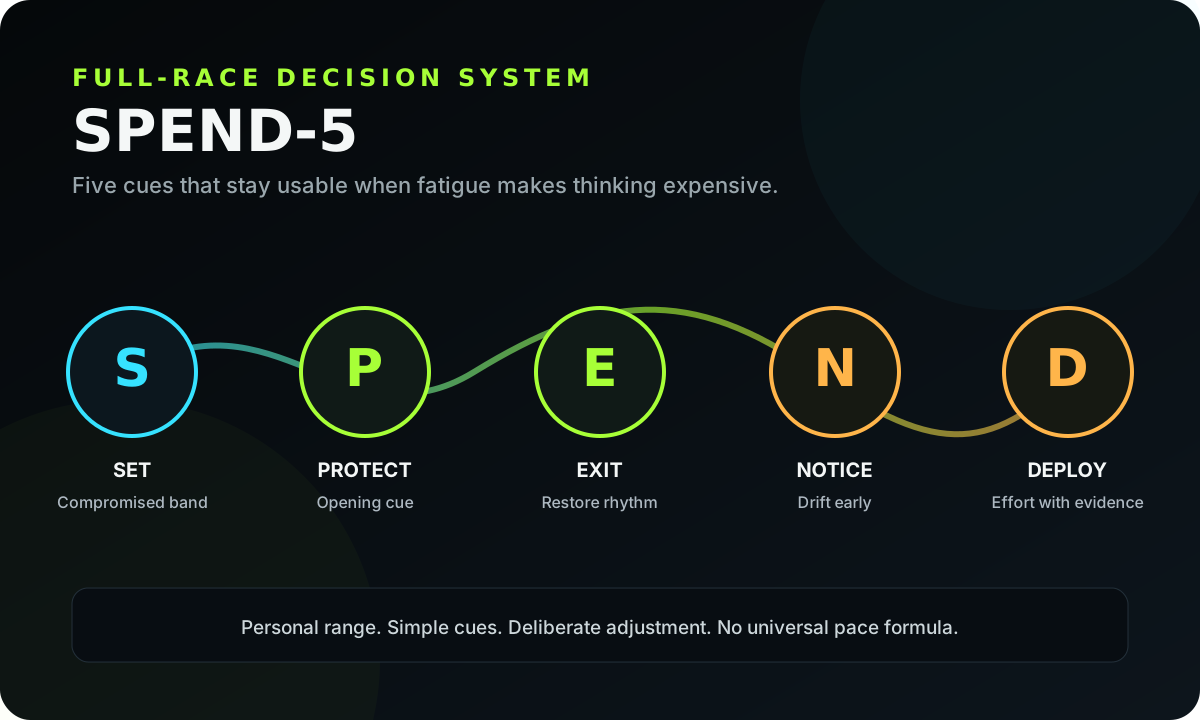
SPEND-5 is LimiterIQ's coaching framework for that context: Set a compromised pace band, Protect the opening, Exit each station deliberately, Notice drift, and Deploy effort late. It is not an official HYROX model, a validated prescription or a promise of a faster result.
A 2026 official-race study observed progressive running-speed decline in 24 male PRO athletes. It described one cohort in one event. It did not prove that slowing is optimal, and its intensity averages are not targets for Open athletes, women, Doubles or other venues. A Doubles partner strategy also needs pair-specific station assignments, switch triggers and fallbacks.
What the evidence actually supports
The strongest HYROX-specific data says running and stations both contribute to performance, while measured effort can vary between them. A 2026 analysis of 39,696 historical PRO and ELITE results found running accounted for about half of total race time in the analysed data and faster running was strongly associated with better overall performance. That is useful context. It is not proof that forcing a faster opening run causes a better result.
A small 2025 simulated Open-format study also found high physiological and perceived effort across the event, with values changing between runs and stations. Its 11-person sample cannot define a universal heart-rate zone, station split or safe intensity. Broader endurance research is equally important: a 2026 network meta-analysis found no consistent winner among imposed fast-start, even or slow-start strategies compared with self-selected pacing.
The practical conclusion is narrower and more useful. Build an individual plan, expose it to representative fatigue, and learn from the full chain of outcomes. Pacing behaves partly like a skill. Repeated task exposure can improve how athletes distribute effort, but no review tells you an exact HYROX practice dose or perfect formula.
S: Set a compromised pace band
Your fresh running pace is a reference point, not the answer. A useful race band is the range you can reproduce after station work while preserving movement quality and decision control. That band may change by training phase, surface, temperature, venue and division.
Start with recent evidence from sessions that resemble the decision you are trying to make. Record the run range, the station before it, station execution, recovery between rounds and how the final repetition compared with the first. Do not reduce the session to the fastest kilometre.
If you need help separating threshold pace from race-specific pace, use the threshold guide. If you want the fresh-versus-compromised comparison, use the race-pace guide. This article owns the race-wide decisions that follow.
P: Protect the opening
The opening decision is not "go slow". It is "do not let novelty set the pace". Crowds, music, taper freshness and early position can all distort effort. Your job is to enter the first station with the plan intact, not to prove fitness before the race has accumulated any station cost.
Choose one observable cue before the start. It could be staying inside your rehearsed band, keeping a specific movement rhythm, or refusing to race another athlete's surge. The cue must be simple enough to use with one tired thought. If opening control is your specific leak, the adrenaline opening-pace guide goes deeper without replacing this full-race framework.
E: Exit each station deliberately
A station can change the first part of the next run. Breathing, posture, grip, local fatigue and congestion can all make an instant pace judgement noisy. Treat the exit as a handover, not a test of courage.
Use a sequence you have rehearsed: clear the station legally, orient to the route, restore the posture and breathing cue that works for you, then settle into the current band. The exact distance is individual. A fixed 50, 100 or 200-metre rule is not supported by the evidence and may not fit the venue.
For route and Roxzone decisions, use the IN-OUT transition audit. To diagnose the specific cost after sled work, use the post-sled diagnosis. For the training protocol, use the controlled 800-metre repeat. SPEND-5 keeps those station-specific tools connected to the full race.
N: Notice drift before it becomes collapse
Drift is information. One slower segment does not automatically mean failure. It may reflect a demanding station, venue geometry, traffic, a penalty, heat or a pace band that was wrong for the day. The decision is to notice the change early enough to respond deliberately.
Use the smallest reliable signals available: pace relative to your rehearsed range, breathing control, technique, cadence, or whether you can execute the next station plan. Heart rate can add context for some athletes, but wrist readings and individual responses vary. There is no evidence-backed universal HYROX heart-rate zone.
| Signal | Question | Possible response |
|---|---|---|
| Run leaves your band | Was the cause the last station, the venue or the opening? | Restore control, then reassess at the next clear marker. |
| Technique degrades | Are you protecting valid work? | Use the reset you practised before failure forces one. |
| Breathing will not settle | Can you still execute the next decision? | Reduce demand until control returns. Stop for concerning symptoms. |
| Plan still feels sustainable | Is there enough race left to justify more? | Hold the band. Do not spend effort only because it is available. |
D: Deploy effort late
Late effort is earned by evidence, not by a motivational rule. Deploy when the remaining work is clear, technique is still legal and the next increase does not destroy the task that follows. For some athletes that is a faster run. For others it is fewer unnecessary pauses, a cleaner transition or simply holding the tested band.
This is why "empty the tank" is a poor universal cue. Pain, dizziness, chest symptoms, unusual shortness of breath or loss of coordination are not pacing problems to push through. Stop and seek appropriate help. Athletes with health conditions, pregnancy, injury or return-to-training questions should use qualified individual guidance.
Practise the decisions, not a fake full race
You do not need to simulate the entire event every week. Choose the decision with the weakest evidence and build a session that exposes it without creating needless fatigue. Keep the first trial conservative. Progress one variable at a time only when technique, recovery and the late-session comparison remain stable.
- Pick one question. Opening control, post-station settling, drift recognition or late deployment.
- Define success before the session. Use a repeatable range plus a movement-quality marker.
- Expose the decision more than once. One successful fresh repetition tells you little about accumulated cost.
- Review the whole chain. Include station quality, transition, run range and recovery.
- Change one variable. Pace, station demand, recovery or volume. Not all four.
Your final race plan should fit on one phone screen or a small card. If it needs a spreadsheet during the race, it is not yet a usable plan.
Do not fix pacing if pacing is only the symptom.
The LimiterIQ assessment organises your answers to help identify the training system most likely to need attention. It does not guarantee a race result.
The one-thumb race card
Sources and limits
- Official HYROX Singles Rulebook, Season 26/27 for the current format and operational rules. It does not prescribe pace or heart rate.
- Gutiérrez-Hellín et al., 2026, HYScience official-race study: 24 male PRO athletes at Madrid 2025. Descriptive and not generalisable as a universal target.
- Rappelt et al., 2026, longitudinal PRO and ELITE analysis: 39,696 public results across seven seasons. Observational, with venue and data limitations.
- Brandt et al., 2025, simulated Open-format study: 11 recreational athletes. Useful physiological description, not a racing prescription.
- Ramos-Campo et al., 2026, network meta-analysis: no consistent advantage for one imposed endurance pacing strategy. Not HYROX-specific.
- Menting et al., 2022, pacing-learning systematic review: experience can inform pacing skill. It does not validate a fixed HYROX protocol.
Evidence was reviewed on 15 September 2026. Research samples do not represent every division, sex, ability, venue or health context. Verify the current rulebook and athlete briefing for your event.