
Do not borrow a universal HYROX transition benchmark. Inspect the current route, name the first legal action, organise before arrival, unwind into the next run, then time the complete segment. Change one decision at a time and compare it against your own repeatable baseline.
The stopwatch is showing you the wrong problem
You leave the rower, look for the exit, adjust your grip, hesitate at a barrier and finally find the run lane. Later, your result shows a Roxzone split. The number is slower than you hoped, so you decide you need to move faster through every transition.
That diagnosis is attractive because it is simple. It may also be wrong.
A transition split can contain route distance, traffic, navigation, set-up choices, equipment contact, breathing control and the first decision about the next run. A faster split can still damage the following kilometre. A slower split can reflect a longer venue path rather than poorer execution. The number tells you where time lived. It does not tell you why.
The mistake is treating every second between station and run as one skill. It is a chain of decisions. The chain is trainable, but only after you separate the pieces.
What the available evidence can actually support
The official HYROX overview describes a repeating race format of a one-kilometre run followed by one functional movement, completed eight times. It also says athletes receive a detailed post-race result with split times. That makes your own result the best starting record for an audit.
A 2026 peer-reviewed analysis used official results from 39,696 PRO and ELITE performances across the 2018/19 to 2024/25 seasons. Its methods separated running time from Roxzone time and noted that exact running distance can differ between events because of the Roxzone configuration. That is strong evidence for two boundaries:
- Roxzone time can be treated as a distinct race segment.
- A transition benchmark from another venue is not automatically comparable to yours.
The dataset does not establish a universal transition target for age-group athletes. It also does not prove that any particular entry speed, exit speed or set-up cue is fastest for you. Those are coaching hypotheses to test, not facts to inherit.
The latest English Singles rulebook located during this refresh was the 2025/26 edition. It includes a dedicated section for confusion between Roxzone IN and OUT. A current 2026/27 English rulebook was not located publicly. Confirm the live rules and technical briefing before applying any course-navigation advice.
Use the IN-OUT transition audit
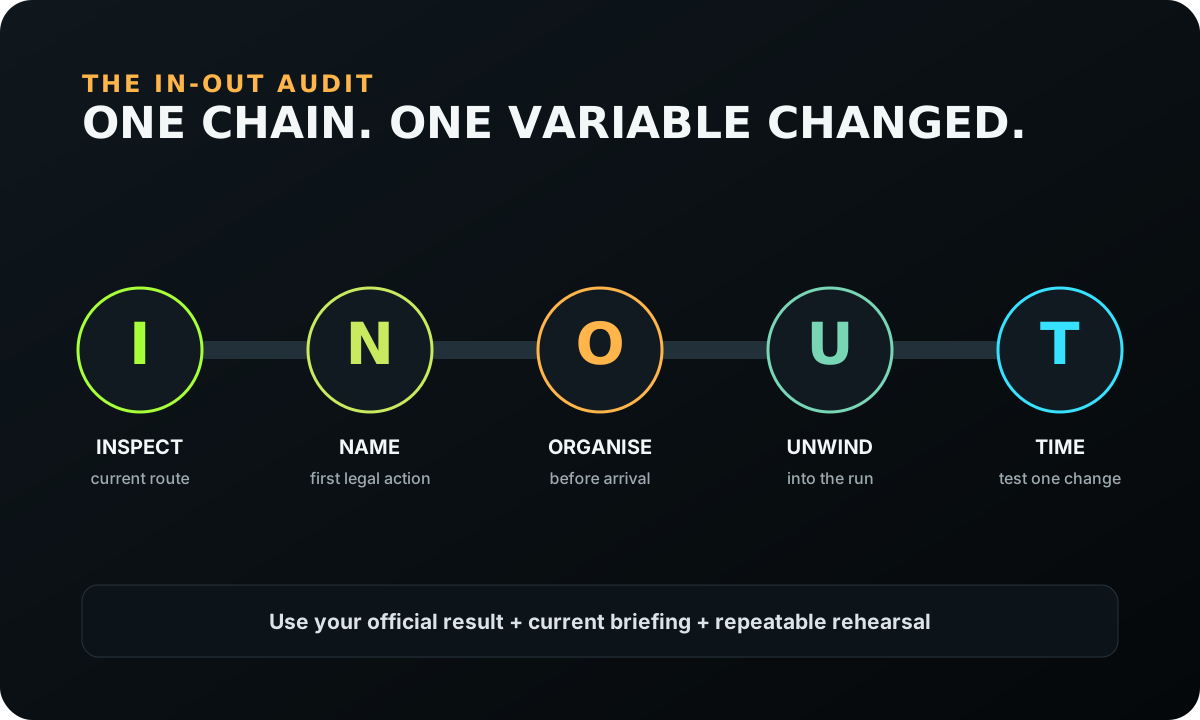
IN-OUT is a LimiterIQ editorial framework, not an official HYROX system. It converts one vague split into five questions. Use it after a race, a simulation or one deliberately designed station-to-run rehearsal.
Inspect the route
Know the current entry, exit, lane direction, equipment approach and briefing changes.
Name first action
Decide the first legal action before arrival so the venue does not force a new conversation.
Organise early
Prepare hands, breathing, line choice and equipment sequence while still moving with control.
Unwind the exit
Leave with a planned first running cue that protects the work still ahead.
Time and test
Compare the complete segment, then change only one variable in the next rehearsal.
Diagnose the split before prescribing speed
Start with the official result and your memory of the segment. Video from a lawful, permitted angle can help, but it is optional. The aim is not to manufacture precision. It is to classify the largest observable problem.
| What you observed | Possible constraint | Next controlled test | Do not assume |
|---|---|---|---|
| You searched for the correct lane | Route knowledge or visual cue failure | Walk the current map and name one landmark | That more speed fixes navigation |
| Work started late after arrival | First-action uncertainty or set-up friction | Rehearse the first legal action from three approaches | That a universal time cap applies |
| The exit felt fast, then the run collapsed | Exit effort, station cost or pacing mismatch | Hold the station constant and test one exit cue | That the transition itself was successful |
| The split differs sharply between venues | Course configuration, traffic or execution | Compare like-for-like sections and note route differences | That total Roxzone time is directly portable |
| You cannot remember what happened | Decision overload under fatigue | Use one verbal cue for entry and one for exit | That the slow number identifies the cause |
Build a venue-specific decision card
A useful race-week card is shorter than a generic transition protocol. It records only what the current venue and your own execution require.
- Current source: save the official map, rulebook and briefing link. Record when you last checked them.
- Entry landmark: choose one visible landmark that tells you where the transition decision begins.
- First legal action: name the first equipment or movement action. If a rule or judge instruction changes it, follow the official direction.
- Exit cue: use one cue for the first controlled part of the next run. It might concern posture, breathing or pace, but it must be something you have rehearsed.
- Failure response: decide what you will do if the lane is busy, the expected equipment position changes or you miss the cue.
This card does not predict the venue. It reduces avoidable decisions while leaving room for race-crew instructions and conditions you cannot control.
Run a one-variable transition experiment
You do not need a full race simulation. Choose one familiar station, reproduce a realistic level of fatigue and compare two or three short trials. Keep load, work duration, recovery and route stable enough to make the comparison useful.
Use your normal entry and exit. Record total segment time, first-action hesitation, movement quality and how the next run settles.
Change one item only, such as the entry landmark, first equipment touch or exit cue. Do not redesign the whole chain.
Repeat the better version. If it only works once, under perfect conditions, it is not yet race-ready.
Do not reward the fastest trial automatically. Prefer the version that is legal, repeatable, clear under fatigue and compatible with the next run. If the time difference is tiny but one version removes hesitation, the decision benefit can still matter. Label that as an observation, not proven race-time gain.
Use your post-race result without over-reading it
After the race, compare your transition record with the race notes you made immediately afterwards. Look for repeated patterns rather than one dramatic number.
- Which entry created a navigation or set-up decision?
- Which exit changed the feel of the next run?
- Did the same cue fail twice?
- Was the venue route meaningfully different from the route you rehearsed?
- Which single change deserves the next test?
Resist turning a split leaderboard into a diagnosis. Other athletes may have different divisions, capacities, traffic, station costs or route execution. Your next useful target is a cleaner decision chain, not somebody else's unexplained number.
Open LimiterIQ, choose Race Analysis in Coach or Settings, and paste your official result. Use the output to locate possible time costs, then add the venue layout, rules and your race notes. LimiterIQ does not observe your route, judge instructions or the cause of a split.
Transition problem or deeper limiter?
Separate the symptom from the constraint.
A messy exit can be a navigation error, a pacing mistake or the cost of the station before it. Use the free LimiterIQ assessment to identify the training constraint most worth investigating next.
Find your current limiterHYROX transition FAQ
What is a good HYROX transition time?
There is no defensible universal target. Course configuration can change the exact running distance and Roxzone path, so use your official result, the current venue briefing and repeatable rehearsal evidence to set your own target.
Does the HYROX Roxzone count as running time?
A 2026 peer-reviewed analysis of official results treated Roxzone time as a separate segment from running time. Check the fields in your own official result because display formats can change.
How should I practise HYROX transitions?
Rehearse one station entry and exit at realistic fatigue. Change one variable, keep the rest stable, then compare decision quality, movement quality and the first controlled part of the next run.
Can LimiterIQ analyse my transition split?
LimiterIQ Race Analysis can use a pasted official result to help identify where time was spent. It does not know the venue layout, judge instructions or why a split changed, so combine the output with your own race notes.
Sources and evidence boundary
- HYROX, About the race. Used for the repeating race-format description and official split-report availability. Last verified 7 August 2026.
- HYROX Singles Rulebook, season 2025/26. Used only to confirm the presence of a Roxzone IN/OUT rules section. Last verified 7 August 2026.
- Schumann et al., Frontiers in Physiology, 2026. Official-result analysis used for the separate Roxzone segment and venue-configuration caveat.
IN-OUT, the diagnosis table and the one-variable experiment are LimiterIQ editorial analysis. They are not official HYROX rules, universal time standards or proven performance guarantees.
This is general training information, not medical advice or an individual coaching prescription. Stop if you feel unwell or unsafe. LimiterIQ is independent and is not owned by, endorsed by, partnered with, sponsored by, certified by, approved by or officially affiliated with HYROX World GmbH. HYROX is referenced descriptively only.