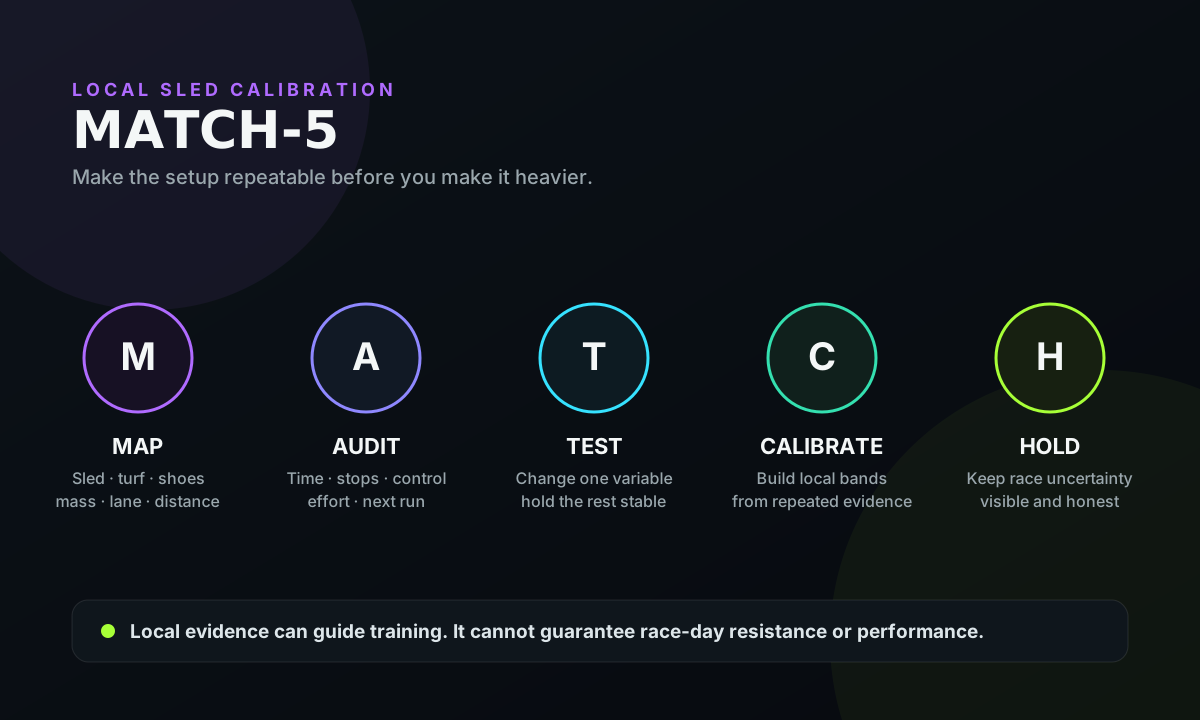
The answer: do not chase a magic plate stack. Map the equipment, audit a repeatable push, test one variable, calibrate local training bands and hold race-day uncertainty. That five-step process is MATCH-5.
You load the same number of kilograms at a different gym and the sled barely moves. Or it flies. The immediate story is that your strength disappeared or suddenly improved.
The equipment changed. Plate mass is only one input. Cross et al. (2017) measured friction and effective loading with one sled on one athletics track while sled mass and speed varied. Linthorne and Cooper (2013) measured different friction coefficients across four sports surfaces. Sled construction and skid material may also matter, but that is a mechanical inference, not an effect quantified by those studies. None provides a HYROX conversion table.
The better question is not, “What plate weight equals race day?” It is, “What can I measure and repeat on this exact setup?”
Start with the official task, then respect the gap
For HYROX Singles Season 26/27, the official rulebook lists the sled push as 50 metres over four 12.5-metre lengths. The listed totals include the sled: 102 kg for Women, 152 kg for Women Pro and Men, and 202 kg for Men Pro. Divisions and rules can change, so the current rulebook remains controlling.
Those totals describe the event task. They do not tell you how 152 kg on one gym sled compares with 152 kg on another. They also do not prove that a lighter local sled is useless. They establish the target context while leaving the equipment-transfer question open.
The official rulebook defines race distance and inclusive mass. It does not publish a formula that converts a gym sled, turf or weighted vest into race-equivalent resistance.
M · Map the setup before judging yourself
A useful log names the environment, not just the plates. If the empty sled mass is known, record it. If it is not, write unknown instead of guessing. Note the exact sled, lane, turf, footwear and distance. Temperature and surface wear may matter when they change materially.
This is not paperwork for its own sake. It stops you comparing two different tasks and calling the difference fitness.
A · Audit the whole push, not one split
Time is useful, but it is not enough. A faster effort achieved with slipping feet, collapsing position or a long recovery cost may not serve the session goal. Record the evidence you can observe consistently.
| Signal | Record | Why it matters |
|---|---|---|
| Output | Distance, total time, length splits and stops. | Shows what the setup allowed today. |
| Control | Foot slip, posture loss, stalling and steering corrections. | Separates movement quality from completion. |
| Effort | A simple repeatable rating and local muscular limit. | Adds context without pretending to be a laboratory measure. |
| Next run | Whether breathing and mechanics settle at the intended pace. | Connects the station to the race problem. |
If you want technique cues during a session, use the focused sled push drill. This article solves a different problem: deciding what the local load means.
T · Test one variable at a time
A sled session can change load, distance, repetitions, rest, surface and exercise order. Change all of them together and the result is hard to interpret. Keep the setup stable and adjust the one variable that matches the session goal.
A study of 90 male high-school athletes found substantial individual variation in the load needed to produce a given reduction in sled-push velocity. Another small study of nine male amateur rugby players found that higher sled-push loads changed lower-limb muscle activity and movement. Neither study was a HYROX race trial, and neither validates a universal percentage. Together, they support individual calibration and caution against assuming every load trains the same task.
C · Calibrate local training bands
Use plain-language bands that describe the task you actually completed. These are LimiterIQ editorial decision labels, not validated physiological zones.
| Local band | What you observe | Best use |
|---|---|---|
| Fluent | Continuous movement, stable foot contact and position, controlled next run. | Technique quality and repeatable station-to-run work. |
| Demanding | Deliberately slower push with control retained and the planned distance completed. | Strength-focused exposure when it fits the wider week. |
| Limit | Stalls, repeated resets, slipping or position loss. | A diagnostic signal, not an automatic target or weekly prescription. |
Progress is not “add weight every week”. It is a repeated setup becoming more controlled, faster at similar effort, or less costly to the next run. When you do add load, earn the change from stable technique, tolerated recovery and the purpose of the session.
General resistance-training guidance supports consistent training and individualised programming over complex universal rules. It does not make time under tension, one progression rate or one heavy exposure schedule mandatory for every athlete.
Keep the log simple enough to use between sets. A phone note with the setup, one output measure, one control note and the next-run response is sufficient. The value comes from comparable entries over time, not collecting every metric your watch can display.
H · Hold race-day uncertainty
Comparable equipment exposure can reduce surprise. It still cannot guarantee how a race venue will feel. Surface wear, lane, temperature, congestion, pacing and the work completed before the sled all remain relevant.
If race-like equipment is available and appropriate, use familiarisation to learn the setup and movement standards. Do not turn one successful session into a predicted split. Use the sled work pacing guide for race execution and the post-sled running guide if the next kilometre repeatedly breaks down.
Do not translate weighted-vest mass into “effective sled kilograms”. Do not attach loose towels or bands or use unmeasured partner resistance on a moving sled. These methods do not recreate sled friction and can introduce avoidable trip, recoil or release hazards.
A one-session MATCH-5 check
- Choose a familiar load and clear lane. Start from work you already tolerate, not an internet percentage.
- Map the setup. Record the sled, known masses, surface, shoes, distance and turn layout.
- Complete a repeatable bout. Use a distance and recovery that fit your current plan and facility rules.
- Audit the result. Capture time, splits, stops, control, effort and next-run response.
- Choose one next variable. Repeat the baseline or adjust only load, distance, repetitions or recovery.
You do not need a maximum effort for this check to be useful. Consistency creates the comparison. If a setup cannot be described or safely repeated, it is weak evidence.
The decision bridge
| What you observe | What it may mean | Next decision |
|---|---|---|
| Same setup, better control or output, similar recovery. | Local capacity may be improving. | Repeat before progressing one variable. |
| Same kilograms, different sled or turf, major performance change. | The task changed. | Create a new baseline. Do not label it strength gain or loss. |
| Push improves, next run repeatedly deteriorates. | Station cost or transition strategy may still be the limiter. | Hold load and inspect pacing, recovery and technique. |
| Musculoskeletal pain or suspected injury without urgent symptoms. | A training adjustment cannot diagnose the cause. | Stop and seek qualified medical or allied-health guidance before returning to high-intensity training. |
| Chest pain or tightness, dizziness, feeling faint or fainting, or unusual shortness of breath. | Urgent medical assessment may be needed. | Stop. Call local emergency services, including 000 in Australia, for loss of consciousness or breathing difficulty, chest pain with breathlessness or dizziness, or chest pain that is severe, worsening or lasts 10 minutes. Otherwise seek prompt medical advice. |
Sources and limits
This guide separates sourced facts from LimiterIQ editorial decisions. The available sled research is dominated by sprint and team-sport settings, not heavy HYROX station trials. Transfer to your race remains an inference that must be tested cautiously.
- HYROX Singles Rulebook 26/27. Current sled push distance, format and inclusive division loads.
- Cross et al. (2017). Friction and effective loading measured with one sled on one athletics track while mass and speed varied.
- Linthorne and Cooper (2013). Different friction coefficients measured across four sports surfaces in sled-towing work with six male rugby players. Not a HYROX pushing study.
- Cahill et al. (2021). Individual load-velocity profiling in 90 male high-school athletes.
- Martínez-Serrano et al. (2021). Load-related movement and muscle-activity changes in nine male amateur rugby players on a specialised treadmill.
- American College of Sports Medicine (2026). General resistance-training progression and individualisation guidance, not HYROX sled equivalence.
- Healthdirect: Chest pain, Fainting and Calling triple zero. Australian medical and emergency escalation guidance.
This is general training education. Use facility-approved equipment and a clear lane. Start from load and volume you already tolerate. Stop if pain, chest pain or tightness, dizziness, feeling faint or fainting, or unusual shortness of breath occurs. Call local emergency services, including 000 in Australia, for loss of consciousness or breathing difficulty, chest pain with breathlessness or dizziness, or chest pain that is severe, worsening or lasts 10 minutes. Seek prompt medical advice for other chest discomfort or persistent or recurrent dizziness or unusual breathlessness. Seek qualified medical or allied-health guidance for musculoskeletal pain, injury or return to high-intensity training.
Make the next training decision simpler.
The free LimiterIQ assessment organises evidence across eight systems. It does not measure sled friction or predict a race split.