Match
Confirm the date printed on your booking. Save it in the race selector so the countdown and training phase use your day.
Melbourne runs across five days, but you race once. MEL-5 turns the exact day on your booking, your current phase and one proven limiter into a plan you can execute.
Free assessment · No card required · Training guidance, not medical advice

The official event window is 9–13 December 2026. That range is useful for planning the trip, not the taper. Your personal countdown must finish on your booked race day.
The MEL-5 field guide keeps the sequence clean: match the date, establish the training phase, limit one constraint, lock logistics, then leave late fitness-chasing alone. It is a planning framework, not an official event protocol or a guaranteed performance formula.
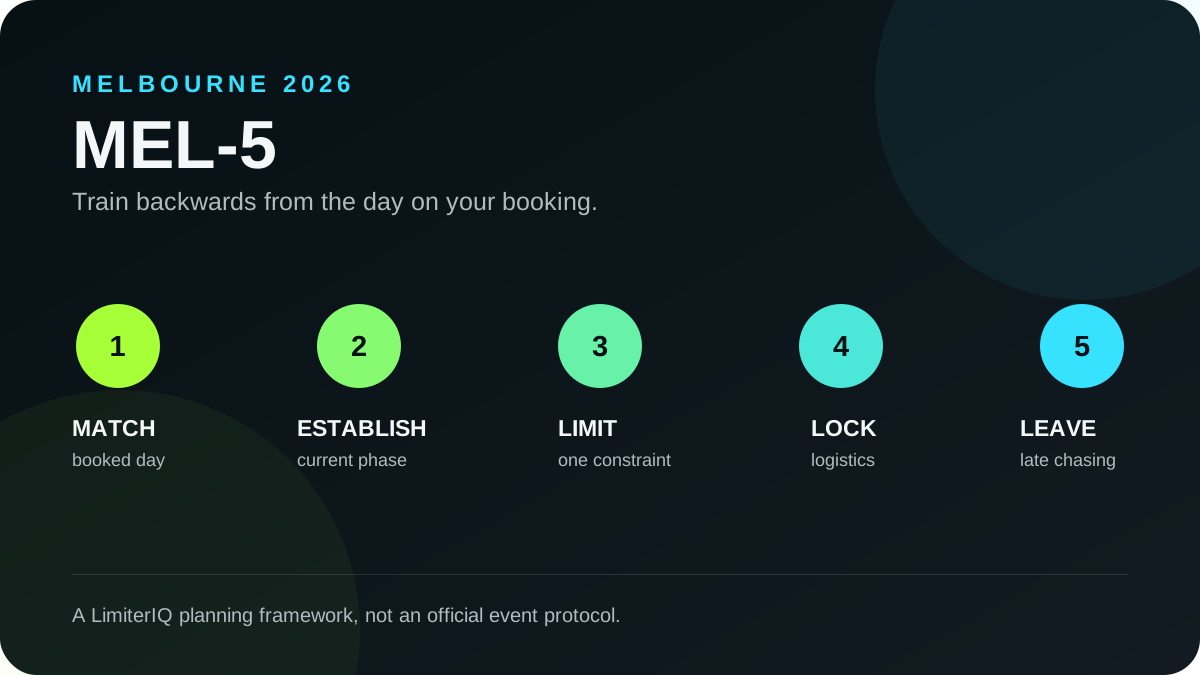
Use these in order. Each decision removes a common source of wasted work or race-week uncertainty.
Confirm the date printed on your booking. Save it in the race selector so the countdown and training phase use your day.
Use the live phase below. A base block, specific block and taper solve different problems.
Name one constraint you can prove. Choose the weakness that changes the next training decision.
Confirm arrival, check-in, ID, kit and spectator access before race week creates avoidable stress.
Inside four weeks, stop trying to buy new fitness with unfamiliar volume, movements or intensity.
A practical HYROX build block you can open at the gym and run from the clock. Every workout totals exactly 60 minutes, with scaling options, equipment swaps, stop rules, and a printable progress tracker.
Fixed general plan, not personalised coaching and not a race-week taper. Preview every inclusion, then scale it to your current training age and health.
The organiser currently lists five provisional race days. The summaries below are planning aids, not start-time confirmations. Use the current official page and your booking as the source of truth.
Men Open, Women Open, adaptive divisions and Open doubles are provisionally spread across the day.
Men Open, Women Open, adaptive divisions and Open doubles are provisionally spread across the day.
Singles Open, adaptive and Pro divisions, Open doubles and relay divisions are provisionally listed.
Men Open, adaptive, Mixed Doubles and Pro doubles are provisionally listed.
Women Open, adaptive and Open doubles are provisionally listed.
Schedule checked on 12 September 2026. See the official HYROX Melbourne event page for the current division timetable.
One static template cannot know what is failing in your training. These phases set the priority. Your limiter decides the prescription.
Build aerobic durability. Establish clean movement baselines. Test the failure point instead of guessing.
Raise compromised running capacity and station repeatability around the limiter you can prove.
Increase race specificity. Rehearse pacing, transitions, standards, and recovery between hard exposures.
Reduce fatigue and unknowns. Keep only familiar intensity, kit, fuel, cues, and decisions.
| Weekly anchor 1 | Durable running. One controlled quality run plus enough easy volume to make race pace less expensive. Progress only when recovery stays stable. |
|---|---|
| Weekly anchor 2 | Limiter exposure. Train the highest-cost constraint while technique is still reliable. Track output drift, not just completion. |
| Weekly anchor 3 | Compromised proof. Pair running and stations at a dose that reveals where execution degrades without turning every session into a race. |
| Weekly anchor 4 | Strength + skill. Preserve force, movement standards, and repeatability. More fatigue is not automatically more specific. |
| Recovery gate | Earn the next load. Adjust for pain, illness, sleep disruption, unusual fatigue, and life stress. Seek qualified care for concerning symptoms. |
Start from sustainable compromised pace, not fresh kilometre pace. Use the calculator to expose impossible split assumptions.
Track rep quality, break timing, and output decay. A fast first set that destroys the next run is not a win.
Rehearse entry, exit, equipment setup, and the first 20 seconds after each station. Remove decisions before fatigue arrives.
Train current movement standards and verify them against the official rulebook. Avoid building a plan on invalid repetitions.
A completed session is not automatically a useful session. Capture enough evidence to know whether the limiter improved without making every week a test week.
Use the same route, machine, load or station setup where practical. Record the conditions when they change.
Track pace drift, set quality, break duration or the first run after a station. Completion time alone can hide the failure.
Progress only when normal recovery remains stable. Pain, illness or unusual symptoms are reasons to adjust and seek qualified care where appropriate.
The event listing names the Melbourne Convention and Exhibition Centre at 1 Convention Centre Place, South Wharf. Event details can change, so keep the organiser and your booking in the decision loop.
| Start time | The organiser says individual start times are generally published about three days before the event. Do not build a precise arrival plan around an estimated wave. |
|---|---|
| Booked day | Start-time changes are not permitted. Use the exact date and division on your booking, then recheck the official timetable. |
| Check-in | Check-in details are currently to be confirmed. Bring identification and do not plan to check in for another athlete. |
| Spectators | An athlete wristband provides venue access on the athlete's race day. The organiser says a separate spectator ticket is needed for other event days. |
| Ticket terms | Transfer, division-change, name-change and refund rules depend on the organiser's current ticket terms and any Flex purchase. Verify the current terms before acting. |
Operational details checked on 12 September 2026 against the official event page and ticket terms.
LimiterIQ turns your answers into a focused training priority. Use it alongside your race splits so the plan targets the weak link instead of spreading effort evenly.
The official event listing currently schedules HYROX Melbourne for 9 to 13 December 2026 at the Melbourne Convention and Exhibition Centre.
The organiser has published a provisional division schedule across all five event days. Match your division to the current official event page, then use the exact day on your booking as the training deadline because the schedule can change.
The official event page says individual start times will be released about three days before the event. Check your booking and the organiser's current instructions because start-time changes are not permitted.
The downloadable PDF includes 20 structured workouts, five 60-minute training days and two rest days each week, scaling options, equipment swaps, stop rules, and a progress tracker.
Start now. The live countdown above selects the right phase: base at 12+ weeks, build at 8 to 12 weeks, race specificity at 4 to 8 weeks, and Race Rescue under four weeks. If the event has passed, review, recover, and rebuild.
Stop chasing new fitness. Protect readiness, keep only familiar intensity, rehearse pacing and transitions, and use the Race Rescue playbook.
No. LimiterIQ is independent and references HYROX descriptively. Verify event details and current standards with the official organiser.
Browse date-aware LimiterIQ race plans.
Lock logistics, kit, pacing, and execution.
Build a plan you can still execute after stations.
Understand the weak-link model behind the plan.
Event dates, venue, provisional schedule and operational details checked against the official HYROX Melbourne event listing on 12 September 2026. Event details can change. Verify before travel or registration.
Privacy-friendly analytics. We use a single self-hosted analytics tool to see which pages help athletes - no ads, no cross-site tracking, no selling your data. Cookie policy.